Get Paid for a Review? Here’s What That Insert Card Is Really Doing

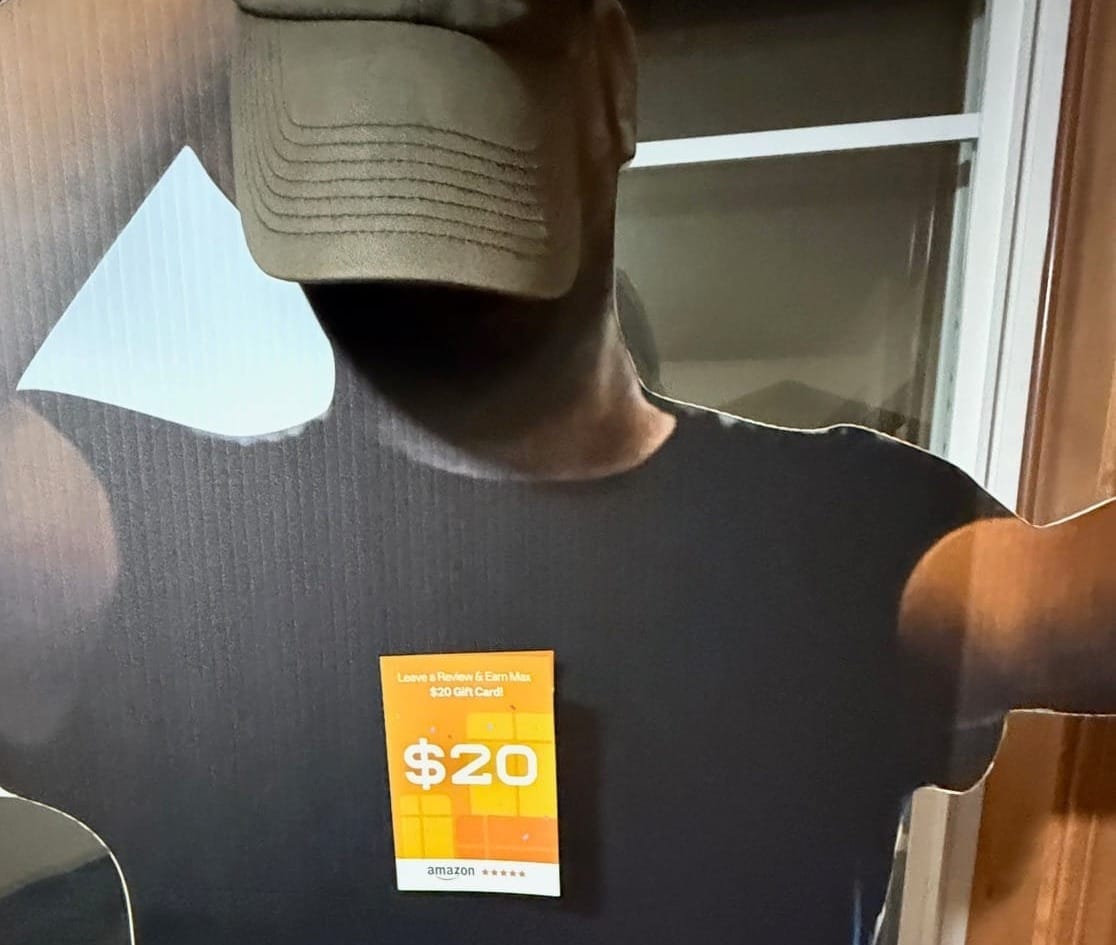
I ordered a few Christmas gifts recently, including these custom photo cutouts (Custom Giant Head and Custom Life Size Cardboard Cutout), and inside the package was something more interesting than the product itself: a pamphlet offering $10 for leaving a review, or $20 if the review included a photo or video.
If you’ve ever searched phrases like “get paid for Amazon reviews” or “free money for leaving a review,” this is exactly the kind of thing people are talking about.
And yes, this happens more often than you’d think.
The Actual Numbers (For Transparency)
Here’s how it shook out for me financially.
I spent $101.77 total, and between the review offers, I received $80 back in Amazon gift cards.
Three of the four items were $17.99. The human-sized custom cutout cost significantly more. Had I stayed under the $20 price point, it would have essentially amounted to getting paid to buy on Amazon.
If I had paid $101.77 for something mediocre and then been nudged to dress it up with praise in exchange for gift cards, I wouldn’t have participated, regardless of the refund amount.
The money didn’t change my opinion.
It just made the purchase easier to justify after the fact.
The Review Incentive Card Trend
Many online sellers include review incentive insert cards inside their packaging. The offer usually looks like this:
- Leave a review → get $10
- Leave a review with photo or video → get $20
- Reward delivered via PayPal, gift card, or refund
These cards are designed to encourage detailed, visual reviews, which tend to convert better for future buyers.
From a marketing standpoint, it makes sense.
From a consumer standpoint, it raises questions.
Is Getting Paid for Reviews Legit?
This is where things get murky.
Writing an honest review is perfectly fine. Offering money specifically in exchange for a review can almost always violate marketplace policies depending on how it’s structured.
That said, these insert cards are everywhere, which is why so many people search:
- Is getting paid for reviews legal?
- Are review incentive cards allowed?
The reality is simple:
- The practice exists
- It’s widespread
- Platforms discourage it, but enforcement is inconsistent
That gray area is exactly why people are curious.
Why Photo and Video Reviews Pay More
Photo and video reviews:
- Increase trust
- Reduce buyer hesitation
- Boost conversion rates
That’s why sellers often offer double the reward if you upload visuals.
If you’ve ever wondered why companies pay more for reviews with photos or videos, now you know.
Why You’re Seeing More of These Offers
There are three main reasons:
- Competition is brutal
Reviews are one of the biggest ranking factors. - Shoppers trust visuals
Real photos beat polished listings every time. - Reviews are cheaper than ads
Paying $20 for a review is often cheaper than running ads.
This is why searches like “companies that pay for reviews” keep increasing.
Should You Do It? Here’s How I Handled It
In my case, I went ahead and did it, without any qualms.
The product I received was genuinely excellent. Solid quality, exactly as described, and clearly not a corner-cutting operation. Because of that, leaving a positive review felt completely natural. The incentive didn’t change my opinion, it just gave me a reason to actually sit down and write the review instead of forgetting about it like most people do.
That distinction matters.
I would not have done this if the product had been poor. I have no interest in tricking someone into buying junk based on a review I padded for personal gain. That kind of behavior erodes trust for everyone, and once reviews stop meaning anything, nobody wins.
In other words:
The reward didn’t buy my honesty.
It just rewarded it.
Do People Ever Handle These Review Rewards Honorably?
Yes, and it’s more common than you might expect.
When people talk about “paid reviews,” they usually imagine fake five-star fluff written purely for cash. In practice, many buyers try to handle these situations ethically.
1. Leaving the Review, Then Editing It Later
Some people leave the review, receive the reward, and update the review later if issues show up with longer use.
This often happens with products that seem fine at first but fail over time. The intent matters here: the reviewer isn’t trying to deceive, they’re updating the record as new information becomes available.
Is it perfect? No.
Is it more honest than pretending the product is flawless forever? Absolutely.
2. Five Stars… With a Very Honest Description
Another approach is leaving a high star rating to satisfy the reward condition, while using the written portion to clearly spell out flaws.
You’ll see reviews like:
- “Five stars for fast shipping, but…”
- “The idea is good, but execution is lacking.”
- “Works, but not nearly as well as advertised.”
Anyone actually reading the review still gets the truth. The star rating may be inflated, but the content isn’t misleading, which is arguably what matters most.
3. Leaving a Neutral or Critical Review and Accepting Whatever Happens
Some buyers simply leave the review they believe is fair, even if it’s three stars or critical, and see whether the seller still honors the reward.
Interestingly, some sellers do. Their real goal is often engagement and feedback, not just praise. When that happens, it’s arguably the cleanest outcome: honest review, transparent transaction, no pretending.
4. Declining the Reward Entirely
This is rarer, but it does happen. Some people leave the review and ignore the reward offer completely because they’re uncomfortable with the incentive structure.
That’s not morally “better", just a different comfort level. Ethics here are personal, not absolute.
The Line I Wouldn’t Cross
For me, the line is simple:
- I won’t praise a bad product
- I won’t hide defects
- I won’t help move junk onto someone else
If a product is excellent, I’ll say so, reward or not.
If it’s mediocre or bad, I won’t dress it up for twenty bucks.
That’s not virtue signaling. It’s just practical. Reviews only work if people trust them, and once you help poison that well, you’re part of the problem.
Final Thought
The product I ordered was forgettable.
The review incentive card was not.
If you’ve ever opened a package and found an offer promising free money or gift cards for a review, now you know what’s behind it, and why so many people are searching for answers.
This isn’t about the item.
It’s about how reviews are bought, sold, and valued online.
And once you see it, you can’t unsee it.